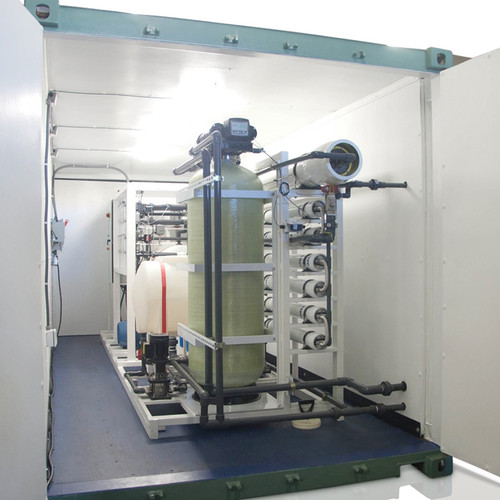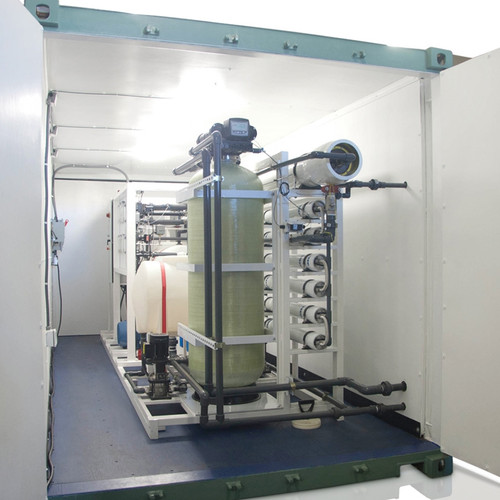


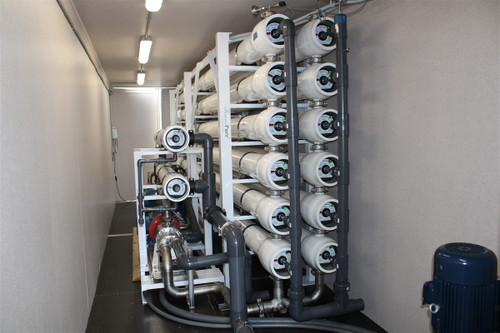
Built and tested, ready to dispatch. Contact us to reserve it, or to discuss configuration for your site.
The ForeverPure SWRO-HE-1000TPD is a containerized high-efficiency seawater reverse osmosis plant producing 264,000 GPD (1,000 m³/day) of potable-quality permeate from seawater at a 36,000 ppm TDS design basis. The complete train — pre-treatment, high-pressure section, energy recovery, membranes, cleaning system, instrumentation and PLC controls — is built and wet-tested inside two ISO 40′ high-cube containers before shipment.
Energy recovery is by Danfoss iSave 70, an isobaric pressure exchanger with an integrated booster pump, paired with a Danfoss APP 46 axial piston high-pressure pump in duplex stainless steel. The membrane array is 72 LG NanoH2O SW 440 GR elements in twelve 6-element Pentair Codeline 80E120 pressure vessels.
Made in USA. Manufactured and tested in Silicon Valley, Santa Clara, California. Built with LG NanoH2O membranes, Danfoss pumps and energy recovery, and Allen-Bradley, IDEC or Siemens electrical components.
How the energy recovery works
The iSave transfers pressure from the brine straight back into the feed, so the high-pressure pump raises only the permeate-equivalent 183 GPM rather than the full 436 GPM. That is what brings specific energy down to roughly 2.2–2.5 kWh/m³.
Why it costs so much less to run. A conventional seawater plant without energy recovery consumes roughly 3.8–4 kWh for every cubic metre of water produced. This system consumes about 2.2–2.5 kWh/m³ — a saving of 1.3–1.8 kWh per cubic metre, or roughly 1,300–1,800 kWh per day at full output, and on the order of 390,000–540,000 kWh a year over 300 operating days. Lower draw also means a smaller and cheaper solar array if the plant is run on renewable power.
Key components
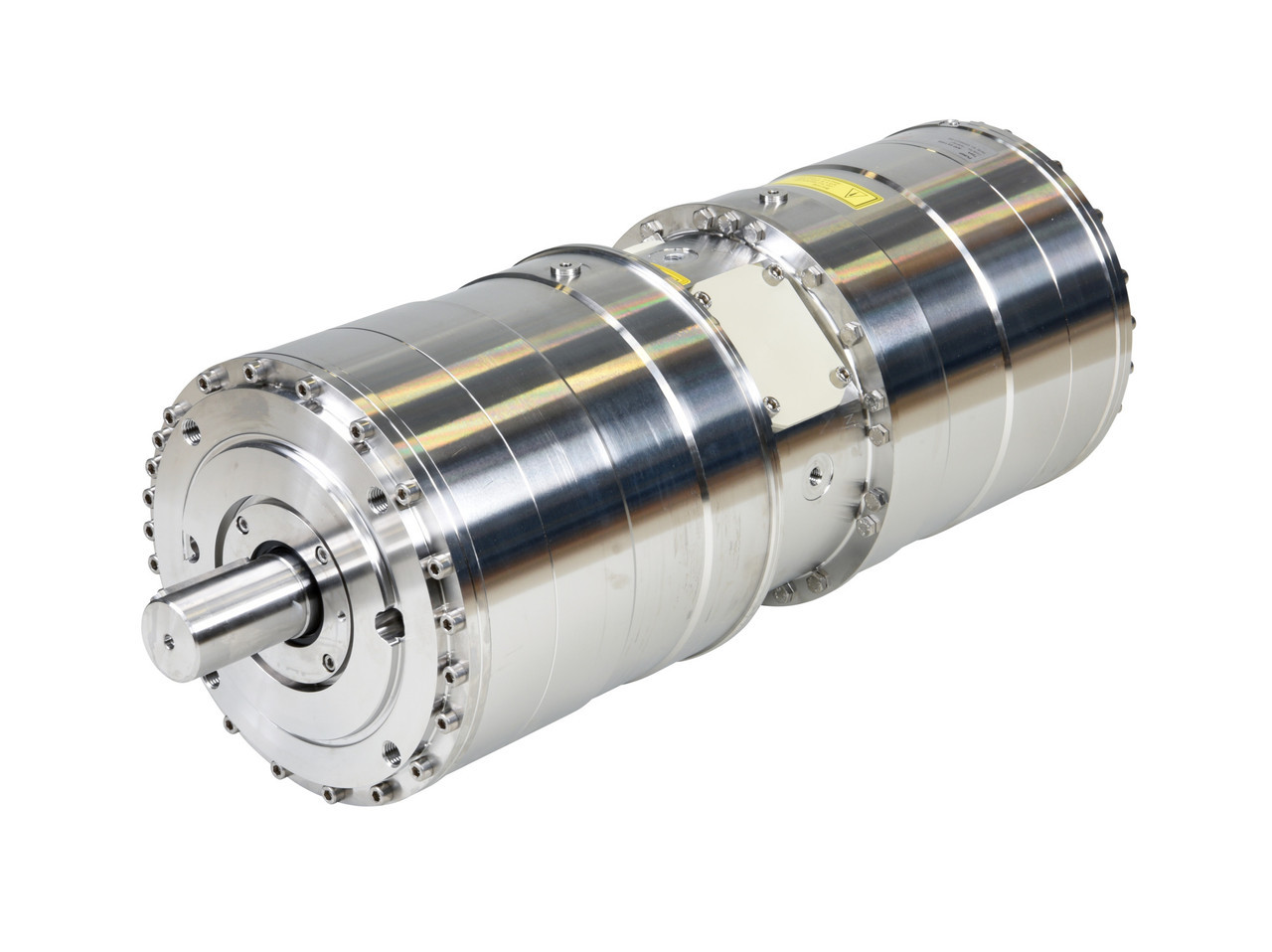
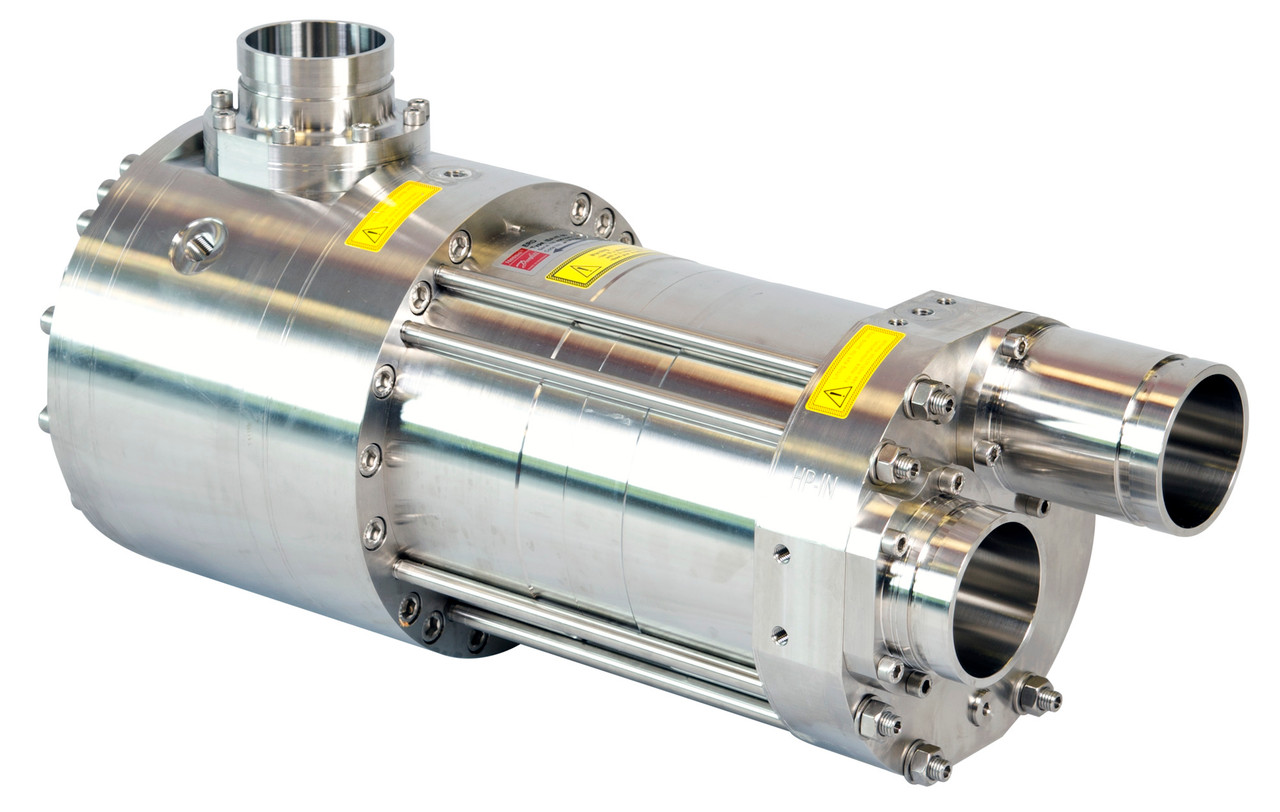
Danfoss APP 46 high-pressure pump
1 × high-pressure pump- Axial piston, positive displacement
- 800 psi working, 1,200 psi maximum discharge
- Duplex stainless steel (UNS S31803)
- Water lubricated — no oil, no gearbox
- 125 HP, 3-phase TEFC, Schneider ATV630 VFD
Danfoss iSave 70 energy recovery
1 × ERD- Isobaric pressure exchanger with integrated booster
- Transfers brine pressure directly into the feed
- Handles the 253 GPM concentrate-equivalent flow
- Greater than 95% energy transfer efficiency
- 30 HP, 3-phase TEFC, Schneider ATV630 VFD
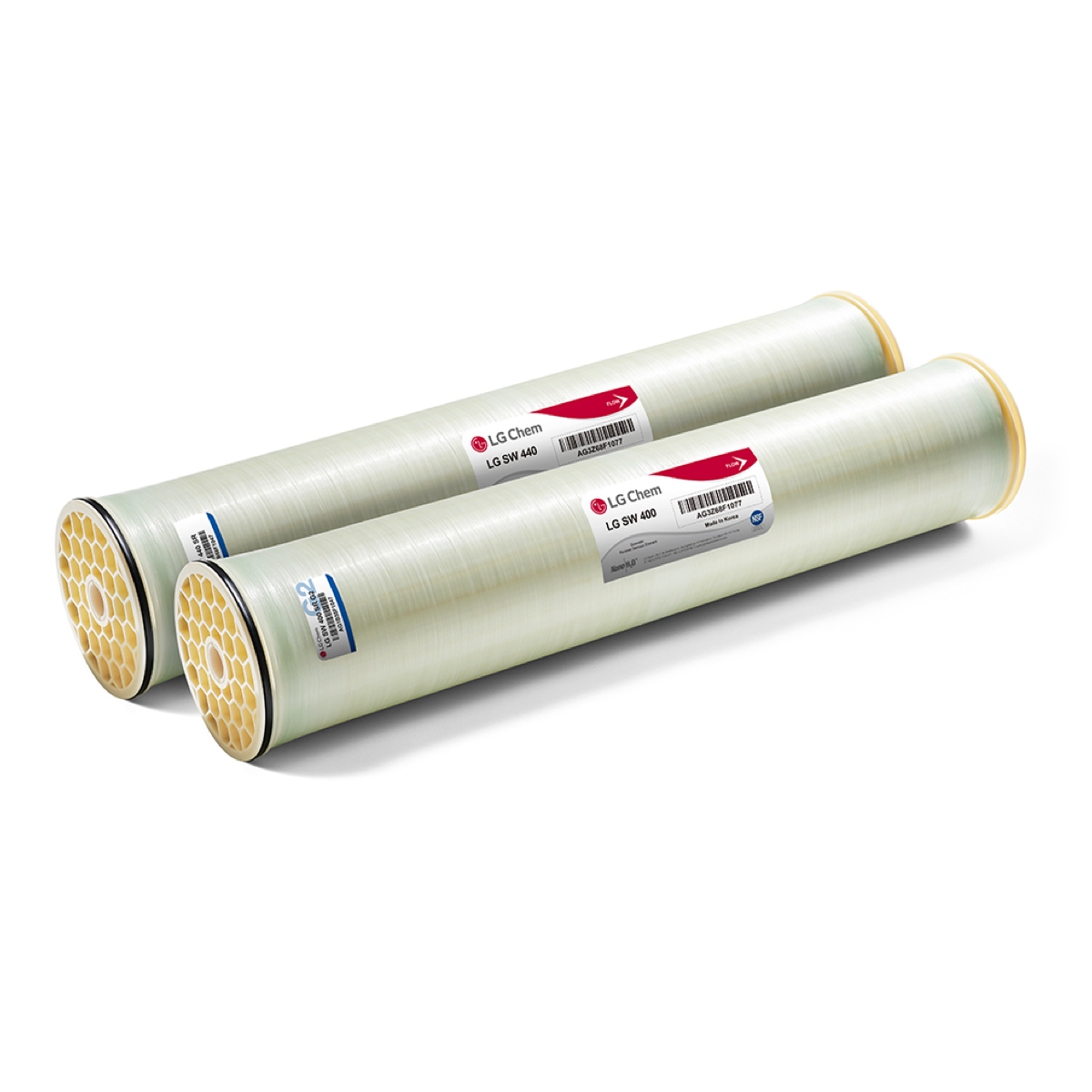
LG NanoH2O SW 440 GR
72 × membrane element- Thin-film nano-composite seawater elements
- 8" × 40", 440 ft² active area each
- 99.85% stabilised salt rejection, 93% boron rejection
- 8,250 GPD nominal flow at LG test conditions
- Average flux approximately 8.3 GFD in this array
- Twelve 6-element FRP vessels, 1,000 psi rated
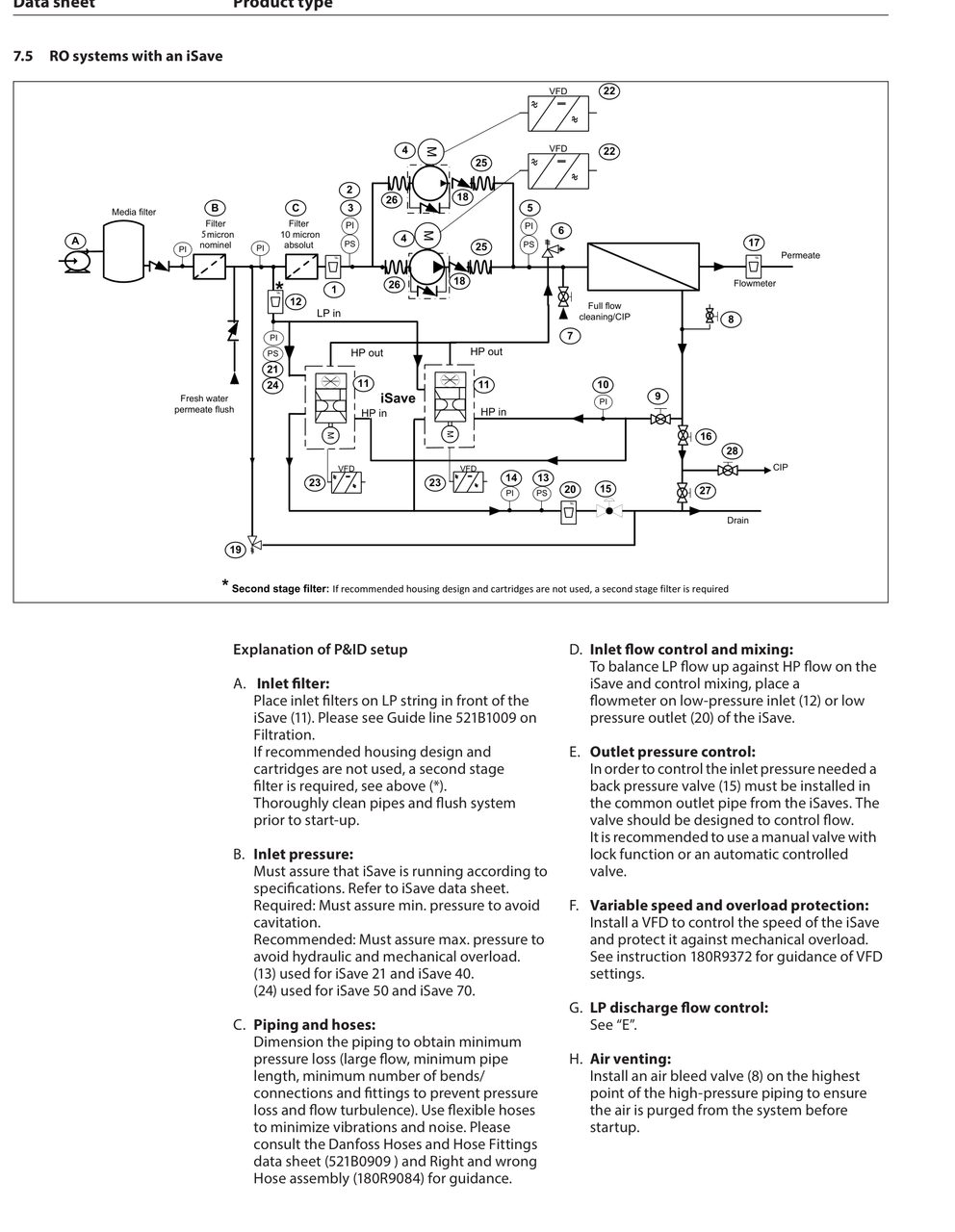
Danfoss iSave process schematic — how the pressure exchanger and booster sit between the feed and brine streams.
Energy recovery flow balance
| Stream | Flow | Pressurised by |
|---|---|---|
| Permeate-equivalent feed | 183 GPM / 41.6 m³/h | Danfoss APP 46 (full pressure rise) |
| Concentrate-equivalent feed | 253 GPM / 57.5 m³/h | Danfoss iSave 70 pressure exchanger, with its integrated booster making up the differential |
| Total membrane feed | 436 GPM / 99.1 m³/h | — |
| High-pressure concentrate to iSave | 253 GPM / 57.5 m³/h | Returned from the array a little below the 800 psi feed pressure |
| Low-pressure concentrate to discharge | 253 GPM / 57.5 m³/h | Leaves the iSave after energy transfer, at roughly 62,000 ppm TDS |
The split is what the component sizing confirms: at 42% recovery the pump only ever sees 41.6 m³/h, inside the APP 46’s 46 m³/h displacement, while the iSave 70 carries 57.5 m³/h of its 70 m³/h rating. Neither unit is asked to handle the full membrane feed.
Technical specifications
| SWRO-HE-1000TPD-36kTDS — design data | |
|---|---|
| Model | SWRO-HE-1000TPD-36kTDS — containerized, single train in two containers |
| Daily production rate | 264,000 GPD / 1,000 m³/day (183 GPM permeate) |
| Design feed water TDS | Up to 36,000 ppm |
| Feed water temperature | 10 – 27 °C (50 – 81 °F) |
| Required feed water pressure | 50 – 70 psi at system inlet |
| Product water quality | Less than 350 ppm TDS (99.0%+ rejection) |
| Recovery rate | 42% |
| Feed water rate | 436 GPM nominal (2,380 m³/day); 460 GPM maximum |
| Concentrate rate | 253 GPM (1,380 m³/day), approximately 62,000 ppm TDS |
| Working pressure | 800 psi (55 bar) at 36,000 ppm and 25 °C; 850 psi (59 bar) maximum |
| Membrane flux | Approximately 8.3 GFD average across 31,680 ft² of active area |
| Net driving pressure | Approximately 350 psi |
| Feed SDI requirement | Less than 4 at the RO inlet |
| Operating pH | 6.5 – 7.0 (adjusted) |
| Energy consumption | Approx. 2.2–2.5 kWh/m³. Includes the RO system and standard feed pump; excludes the product water delivery pump. |
| Net connected load | Approximately 130 kW |
| Containers | Two (2) ISO 40′ high-cube, 40′ L × 8′ W × 9′6" H each |
| Shipping weight | Approximately 28,000 lb (12,700 kg) dry per container; about 35,000 lb per container water-filled in operation |
| High pressure pump | Danfoss APP 46 axial piston, duplex stainless steel; 125 HP 3-phase TEFC motor, Schneider ATV630D90N4 VFD |
| Energy recovery | Danfoss iSave 70 isobaric pressure exchanger with integrated booster, greater than 95% efficiency; 30 HP 3-phase TEFC motor, Schneider ATV630D22N4 VFD |
| Membranes | 72 × LG NanoH2O SW 440 GR nano-composite seawater elements, 8" × 40", 440 ft² each, 99.85% stabilised salt rejection (99.7% minimum), 93% boron rejection, 8,250 GPD nominal flow at LG test conditions |
| Membrane housings | 12 × Pentair Codeline 80E120 filament-wound fiberglass, 8" bore, 6-element, side port, 1,000 psi rated |
| Pre-filtration | 5-micron cartridge sediment filters in fiberglass housings, 300+ GPM rating, 2 units |
| Multi-media filtration | 48" D × 72" H composite / fiberglass tanks, 2 units, automatic backwash to approx. 20 microns |
| High pressure piping | 2205 duplex stainless steel, rated above 1,200 psi |
| Low pressure piping | Schedule 80 PVC or reinforced high pressure PVC, 150 psi rating |
| Controls | Allen-Bradley MicroLogix 1400 PLC with 15" C-More colour touchscreen HMI — start/stop, sequential and alarm control |
| Power supply | 480 V / 3-phase / 60 Hz |
| Structural design basis | IBC 2021 / ASCE 7-22; wind design speed up to 145 mph. Seismic category is site-specific. |
| Foundation | Flat reinforced concrete pad, level to within 1/4"; container twist-lock anchors or welded plates |
| Country of origin | Made in USA — Santa Clara, California |
| Availability | One unit built and available; ships in 3–4 weeks. Contact ForeverPure for the lead time on additional units. |
Containerisation
The plant ships as two ISO 40′ high-cube containers, split so that the wet high-pressure train and the pre-treatment and control equipment travel separately and can be set down side by side on site.
| Item | Specification |
|---|---|
| Container 1 | RO membrane rack, high-pressure pump, iSave energy recovery, CIP system and permeate flush system |
| Container 2 | Pre-treatment (multi-media filters, cartridge filtration), chemical dosing and the control system |
| External dimensions | 40′ L × 8′ W × 9′6" H each |
| Material | Corten steel, marine-grade corrosion resistant |
| Interior | Epoxy-coated floor and walls, anti-slip flooring |
| Insulation | Thermal insulation for tropical and arid climates |
| Lighting and ventilation | LED interior lighting throughout; exhaust fans with filtered air intake, HVAC provisions |
| Access | Double doors at the rear plus a personnel door in the side of each container |
| Electrical entry | Weatherproof cable glands; main disconnect on the exterior |
| Pipe penetrations | Reinforced bulkhead fittings with flanged external connections |
| Lifting and handling | Standard ISO corner castings and forklift pockets |
Factory walk-through
Seven minutes inside a finished SWRO-HE-1000TPD before it shipped: the twelve Pentair Codeline vessels on the ForeverPure rack, the duplex stainless high-pressure manifold, the high-pressure pump and motor, the control cabinet, and the insulated container interior with its LED lighting and side personnel door.
Pre-treatment, post-treatment and auxiliary systems
| System | Description |
|---|---|
| Multi-media filtration | Graded media bed — larger, lower-density granules above finer, higher-density layers — filtering sand and sediment to approximately 20 microns. Backwashes automatically when the bed clogs, saving cartridge cost. Corrosion resistant composite and fiberglass tanks, 48" D × 72" H, 2 units. A third unit is available for high-turbidity feed water. |
| Cartridge pre-filtration | 5-micron cartridge sediment filters in fiberglass housings reduce suspended solids ahead of the high-pressure section, protecting the pump, the energy recovery device and the membrane elements. 300+ GPM rating, 2 units. |
| Antiscalant dosing | Metering injection of antiscalant ahead of the cartridge filter to prevent carbonate, sulphate and silica scaling on the membranes. Rate adjustable by stroke length and percentage; typically 3 ppm in the feed. |
| Biocide dosing | Sodium hypochlorite metered ahead of the multi-media filters to control bio-fouling in the plant. |
| Dechlorination | Sodium metabisulfite metered after the multi-media filters and before the cartridge filter, so no free chlorine reaches the membranes. |
| pH adjustment | Acid dosing before the cartridge filter to hold the feed at pH 6.5–7.0 for optimal rejection. |
| Chlorine dosing (post-treatment) | Metering injection into the product water stream, preventing bacterial growth in the product tank and the distribution system. |
| Feed water booster pump | Optional, not included. Delivers feed water at 50–60 psi at the required flow. Grundfos or equivalent, 316 stainless steel. Intake conditions vary by site — consult ForeverPure for the right pump for your project. |
| Permeate water flush | Pumps permeate into the membrane housings before every shutdown and start-up, so high-salinity water cannot permeate to the product side while the plant is idle. Maintains product quality and extends membrane life. |
| Built-in membrane cleaning (CIP) | Includes a 316 SS high-flow pump. Cleans and sanitises the membrane system, initiated from the control panel. Recommended periodically, or when the differential pressure lead-to-tail exceeds 30 psi. |
| High product TDS diversion | If product TDS rises above a preset value the system alarms and diverts the off-specification water to drain. |
Instrumentation and controls
| Item | Detail |
|---|---|
| Water quality monitors | Myron-II-HL controllers with 4–20 mA output on feed (0–100,000 ppm) and product (0–5,000 ppm), giving real-time water quality data. |
| Pressure transmitters | Prosense PTD25, 4–20 mA — feed and product 0–150 psi, high pressure 0–1,000 psi (×2), drain line 0–150 psi. |
| Flow meters | Electromagnetic, 4–20 mA — feed 0–500 GPM, product 0–400 GPM, iSave 0–400 GPM, high-pressure pump 0–500 GPM. |
| Temperature | PT100 RTD, 1/4" diameter, 316 SS, 0–200 °F. |
| Pressure gauges | Liquid filled, 316 SS — feed water, working and concentrate pressure. |
| Pressure switches | AutomationDirect MPS25 low and high pressure switches, adjustable, normally closed. |
| PLC | Allen-Bradley MicroLogix 1400 (1766-L32AWA) with relay output and three 4-channel analog input modules. |
| Operator interface | C-More EA9 15" colour touchscreen. |
| Drives | Schneider ATV630D90N4 (125 HP, high-pressure pump) and ATV630D22N4 (30 HP, iSave), each with a matched line reactor and Safe Torque Off. |
| Enclosure | Rittal 64" × 48" × 15", NEMA 4X equivalent, with a 300 A frame main breaker on a rotary handle disconnect. |
| Annunciation | Patlite green / amber / red stack light with buzzer. |
| Communication | Ethernet/IP and Modbus RTU ready; remote monitoring capable. |
| Start permissive conditions | Power on; start button pushed; low pressure switch closed; product tank level below high level; pre-treatment ready; VFD ready with no fault. |
| Automatic shutdown conditions | High working pressure; low inlet pressure below 20 psi; starter overload trip; product water storage tank level high; emergency stop pushed; VFD fault; product TDS above setpoint (auto-divert). |
Preventive maintenance at a glance
| Task | Frequency | Detail |
|---|---|---|
| Record TDS, pressure and flow | Daily | Compare against commissioning baseline |
| Check dosing tank levels and inspect for leaks | Daily | Antiscalant, hypochlorite and metabisulfite; visual check of HP piping, fittings and vessels |
| Verify multi-media backwash | Weekly (automatic) | Confirm the cycle runs and check turbidity |
| Replace 5-micron cartridges | Every 6–8 weeks | Or when differential pressure exceeds 10 psi |
| Clean and calibrate TDS meters | Monthly | Calibration standards; replace probes annually |
| Calibrate pressure transmitters and flow meters | Quarterly | Verify the 4–20 mA signal against a reference |
| CIP membrane cleaning | As needed | When differential pressure rises 15% or permeate flow drops 10% |
| Inspect the APP 46 high-pressure pump | Every 4,000 hours | Seals, pistons and valve plates |
| Inspect the iSave 70 energy recovery device | Every 6,000 hours | Vanes, rotor and port plates |
| Full electrical panel inspection | Annually | Connections, terminal tightness and insulation |
| Replace RO membranes | 5–7 years | Based on normalised data trending |
Warranty
| Component | Provider | Terms |
|---|---|---|
| Complete RO system | ForeverPure | 12 months from commissioning or 18 months from shipment, whichever comes first |
| APP 46 high pressure pump | Danfoss | 24 months from commissioning |
| iSave 70 energy recovery device | Danfoss | 24 months from commissioning |
| RO membranes | LG Chem / NanoH2O | Prorated, 3–5 years per manufacturer terms |
| Pressure vessels | Pentair | Manufacturer’s standard warranty |
| VFD drives | Schneider Electric | Manufacturer’s standard warranty |
Warranty is subject to correct installation, operation within the stated design envelope, and the pre-treatment and chemical dosing regime described above.
One unit available now — ships in 3–4 weeks. Request a tailored design and quotation for your site.
Request a quote & sizing consultationCompare seawater desalination system capacities
Not sure which size fits your project? Explore the full range or get free sizing help from our engineers.
All Seawater Desalination Systems (200 GPD–1M GPD) ·
Desalination Machine Buyer’s Guide ·
264,000 GPD Desalination Plant (Open-Frame) ·
132,000 GPD Seawater Desalination Plant ·
530,000 GPD High Efficiency Plant
Frequently asked questions
What does a 264,000 GPD containerized plant serve?
At 264,000 GPD (1,000 m³/day) the plant suits municipal supply, large hospitality and industry — roughly the daily potable water for 8,000–12,000 people.
What is the benefit of the containerized design?
The plant is built, wired and wet-tested inside two ISO 40ft high-cube containers before it ships, so it arrives turnkey. On site it needs only feed water, power and a brine discharge connection, which makes it well suited to remote sites, rapid deployment and disaster relief.
Why two containers rather than one?
Splitting the plant keeps the wet high-pressure train — membrane rack, high-pressure pump, energy recovery device, CIP and flush — separate from pre-treatment, chemical dosing and the control panel. The two containers set down side by side on a single pad and are connected with flanged bulkhead fittings, which keeps each lift within normal ISO handling limits and keeps the electrical enclosure out of the wet room.
How does the Danfoss iSave save energy?
The iSave is an isobaric energy recovery device: it combines a pressure exchanger and a booster pump in one unit and transfers pressure directly from the high-pressure brine into the incoming feed. Because it pressurises the concentrate-equivalent share of the feed, the high-pressure pump is sized only for the permeate-equivalent flow — 41.6 m³/h against the iSave’s 57.5 m³/h. Specific energy lands at approximately 2.2–2.5 kWh/m³, against roughly 3.8–4 kWh/m³ for a conventional seawater plant without energy recovery.
What feed-water salinity can it handle?
The design basis is 36,000 ppm TDS at 25 °C, where the plant produces 1,000 m³/day at 800 psi feed pressure with permeate below 350 ppm. Maximum working pressure is 850 psi, which gives headroom for colder or more saline feed — confirm the operating point against your own feed-water analysis before purchase.
Which membranes does it use?
Seventy-two LG NanoH2O SW 440 GR nano-composite seawater elements, 8 inch by 40 inch with 440 ft² of active area each, 99.85% stabilised salt rejection and 93% boron rejection, arranged in twelve 6-element Pentair Codeline 80E120 fiberglass pressure vessels rated to 1,000 psi. That is 31,680 ft² of active area, giving an average flux of about 8.3 GFD at rated output.
What are the utility requirements?
480 V, 3-phase, 60 Hz with a net connected load of about 130 kW, feed water delivered at 50–70 psi with an SDI below 4, and a brine discharge route for 253 GPM at roughly 62,000 ppm TDS. The foundation is a flat reinforced concrete pad level to within a quarter of an inch.
Source: ForeverPure “SWRO-HE-1000TPD-36kTDS” techno-commercial proposal (2026) and the earlier “Model SWRO-HE-1000 TPD — 264,000 GPD / 1000 m³/Day Containerized High Efficiency Seawater Reverse Osmosis Desalination System” specification (2024), together with the accompanying LG Chem Design membrane performance projection and the ForeverPure 1000 CMD HE SWRO System Operation Manual. Average flux is stated as the arithmetic result of rated permeate over the installed 31,680 ft² of active area. Specifications are subject to change and to confirmation against your feed-water analysis — please confirm all critical figures with ForeverPure engineering before purchase. Danfoss, APP and iSave are trademarks of Danfoss A/S; NanoH2O is a trademark of LG Chem; Codeline is a trademark of Pentair. Used here to identify the components supplied.