

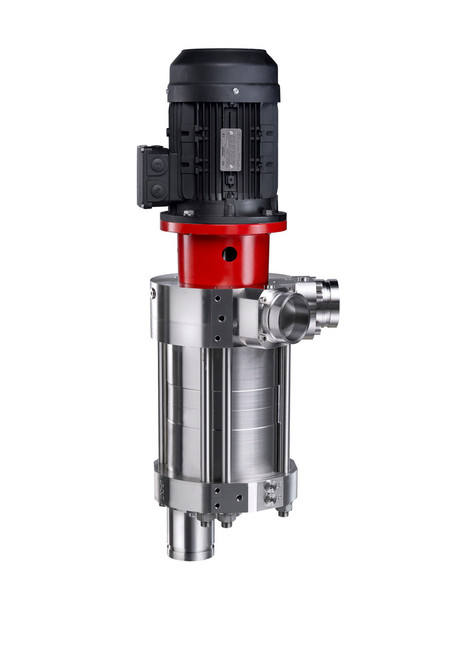
The Danfoss MPE 70 (code 180F7070) is an active isobaric energy recovery device for medium and large seawater reverse osmosis plants. Unlike a conventional rotary pressure exchanger, whose rotor is driven only by the flow, the MPE 70 drives its rotor with an electric motor under VFD control. That removes the risk of rotor overspin, keeps the unit turning through biofouling, and holds mixing down across the whole flow range rather than only at the design point.
Danfoss rates the range for SWRO trains from about 1,500 m³/day upwards, installed in parallel-coupled arrays.
Documentation & Drawings
Technical Specifications
| This Configuration | |
| Code number | 180F7070 |
| Model | MPE 70, bare shafted |
| Type | Active isobaric energy recovery device (motor-driven rotor) |
| Alternative version | 180F7066 (with IEC motor) |
| Efficiency | |
| Total efficiency | 96% (at 70 m³/h, balanced flow, 60 barg HP out — includes motor and VFD power) |
| Flow | |
| Flow at min. speed, HP out | 50 m³/h (220 gpm) |
| Flow at max. speed, HP out | 70 m³/h (308 gpm) |
| Max. allowable working flow, LP in | 70 m³/h (308 gpm) |
| Peak flow, LP in | 105 m³/h (462 gpm) |
| Typical lubrication flow at 60 barg (871 psig) | 16 l/min (4.2 gpm) |
| Speed | |
| Min. speed | 625 rpm |
| Max. speed | 875 rpm |
| Pressure | |
| Max. pressure HP out (MAWP) | 83 barg (1200 psig) |
| Min. pressure HP out | 40 barg (580 psig) |
| Min. pressure HP in, intermittent | 2 barg (29 psig) |
| Max. differential pressure (HP in − HP out) | 0.66 barg (9.6 psig) |
| Max. pressure LP in (MAWP) | 5 barg (72 psig) |
| Max. pressure LP in, peak | 10 barg (145 psig) |
| Min. allowable working pressure LP in | 2 barg (29 psig) |
| Max. differential pressure (LP in − LP out) | 0.74 barg (10.73 psig) |
| Max. static test pressure (HP in / HP out) | 108 barg (1566 psig) |
| Max. static test pressure (LP in / LP out) | 13 barg (189 psig) |
| Operating Conditions | |
| Media temperature | 2 – 40°C (36 – 104°F) |
| Ambient temperature | 0 – 50°C (32 – 122°F) |
| Filtration requirement (nominal) | 5 µm melt-blown |
| Salinity increase at membrane (40% recovery, balanced flow) | 2 – 3% |
| Sound pressure level LPA at 1 m | 85 dB(A) |
| Mechanical | |
| Weight (dry) | 114 kg (251 lb) |
| Weight (in operation with water) | 119 kg (262 lb) |
| Footprint (vertical position) | 0.175 m² (1.9 ft²) |
| Max. allowable working torque | 15 Nm (11 lbf-ft) |
| Max. starting torque (stick/slip) | 90 Nm (66 lbf-ft) |
| Connections | 3″ Victaulic |
| Identification | |
| Manufacturer | Danfoss High Pressure Pumps |
| Data sheet reference | Danfoss AQ367027814446en, §4.1 |
Videos
Danfoss MPE 70 ERD animation — how the active pressure exchanger works
Energy-efficient parallel SWRO design using Danfoss pumps and MPE 70 ERDs
Videos courtesy of Danfoss High Pressure Pumps.
Where the MPE 70 Fits
The MPE 70 passes brine (concentrate) flow, up to 70 m³/h (308 gpm) per unit. At the 40–45% recovery typical of seawater RO, one unit at full flow supports roughly 47–57 m³/h of permeate — about 1,120–1,380 m³/day (296,000–365,000 GPD).
Danfoss positions the range for trains from 1,500 m³/day and above, so a plant of that size and larger uses several units in a parallel-coupled array. Because the rotor is motor-driven, the array does not need the redundancy a passive ERD requires to cover overspin or fouling stops.
Typical duties: municipal and utility-scale seawater desalination, large industrial SWRO trains, and plants where feed quality varies enough that a passive rotor would be at risk of stalling.
Active vs. Passive Energy Recovery
In a conventional isobaric ERD the rotor spins only because the flow pushes it. That works well at the design point, but flow excursions can drive the rotor faster than intended (overspin), and biofouling can slow or stop it. Both cost efficiency, and both are usually handled by installing extra units for redundancy.
- No overspin risk — motor control fixes the rotor speed, so the unit runs safely at variable and maximum flow.
- Lower mixing — salinity increase at the membrane stays at 2–3% at 40% recovery, and stays there as conditions drift.
- Keeps turning through biofouling, so no rotor stops.
- Less redundancy needed in the array, and speed data the control system can actually use.
Frequently Asked Questions
What is the difference between 180F7070 and 180F7066?
How does the MPE 70 differ from the iSave?
Do I need a variable frequency drive?
What pre-filtration does it need?
How many units will my plant need?
How is it shipped?
Specifications reproduced from the data sheet in Danfoss operating guide AQ367027814446en (§4.1), cross-checked against data sheet AI366651348409 (2024.02). Danfoss has renamed the range MPE S 70 in the current revision; performance data is unchanged. MPE® is a trademark of Danfoss A/S. Danfoss reserves the right to alter specifications without notice; confirm critical values against the current data sheet before purchase.