
| Identification | |
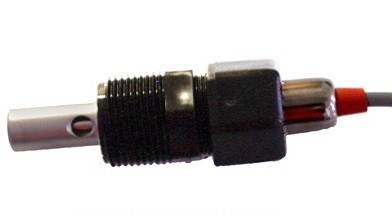
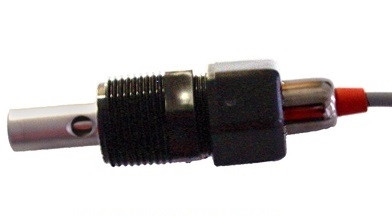
| Model / SKU | CS51R |
| Brand | Myron L® Company |
| Country of Origin | United States |
| Product Type | Conductivity sensor, RTD temperature element |
| Sensor | |
| Sensor Type | Conductivity sensor, RTD temperature element |
| Max. Pressure / Temperature | 100 psi / 6.9 bar at 100 °C / 212 °F |
| Process Connection | |
| Process Connection | 3/4" NPT standard; compatible with BSP |
Myron L publishes an application bulletin for each of these. The summaries below are ours; the linked bulletins are Myron L’s own and open in a new tab.
Automatic Rinse Tank Controls
Metal finishing, plating, manufacturing
Rinsing is where plating and metal-finishing lines consume most of their water. Conductivity rises as drag-out contaminates the rinse tank, so controlling make-up water on a conductivity set point replaces continuous overflow with water added only when it is actually needed. Myron L reports users cutting rinse water use by up to 80%, which lowers both the water bill and the volume of effluent that has to be treated.
Measured here: Conductivity / TDS
📄 Automatic Rinse Tank Controls Application Bulletin (PDF)Boilers & Cooling Towers
Facilities, HVAC, process steam
Boilers and cooling towers concentrate dissolved minerals as water boils off or evaporates, and past a certain point that causes either scale or corrosion. Myron L notes that as little as 1/8 in. of scale can cost a boiler 18% of its efficiency and a cooling-tower heat exchanger 40%. Conductivity or TDS tracks the cycles of concentration so blowdown and bleed-off happen at the right moment — enough to protect the plant, not so much that water and treatment chemicals are wasted.
Measured here: Conductivity / TDS, pH, ORP, temperature, LSI
📄 Boilers & Cooling Towers Application Bulletin (PDF)Circuit Board Cleanliness Testing
Electronics manufacturing
Ionic residue left on a finished board degrades insulation resistance and dielectric strength. Rather than send boards to a lab, the board is rinsed in a measured volume of extract solution — 75 parts by volume of 99% isopropyl alcohol to 25 parts deionised water — and the conductivity of that extract is read directly, giving a fast production-floor check of ionic contamination historically benchmarked against MIL-P-28809. The mixture must itself read no more than 0.166 µS/cm before use, or the result means nothing.
Measured here: Conductivity, resistivity
📄 Circuit Board Cleanliness Testing Application Bulletin (PDF)Deionized Water
Laboratory, pharmaceutical, electronics, plating
Ion-exchange resin strips cations and anions from water until its exchange capacity is spent. Because the purity of DI water is defined by what little remains dissolved in it, resistivity is the natural measurement — it climbs as purity rises and falls sharply as a bed exhausts. Monitoring resistivity continuously is what tells you to regenerate or swap a bed before off-spec water reaches the process.
Measured here: Resistivity, conductivity / TDS
📄 Deionized Water Application Bulletin (PDF)Environmental Monitoring
Wastewater, stormwater, surface water
Discharge to waterways, to municipal sewers and increasingly stormwater runoff all sit under permit limits, and demonstrating compliance means measuring at many points rather than one. Conductivity, pH, ORP, dissolved oxygen and nitrate together characterise both the health of a receiving water and the quality of an effluent, and handheld instruments make it practical to sample where the water actually is.
Measured here: Conductivity / TDS, pH, ORP, dissolved oxygen, nitrate, temperature
📄 Environmental Monitoring Application Bulletin (PDF)Fountain Solutions (Lithographic Printing)
Commercial printing
In lithography the dampening (fountain) solution has to be held at the right concentration: too weak and the non-image area dries out, giving tinting, scumming and blanket piling; too strong and the ink over-emulsifies, weakening colour and changing its body and flow. pH was the traditional test, but most modern fountain solutions are buffered, so pH barely moves even when strength changes a lot. Conductivity tracks concentration directly and is now the more reliable control.
Measured here: Conductivity, temperature, pH
📄 Fountain Solutions (Lithographic Printing) Application Bulletin (PDF)Hemodialysis & Dialysate
Clinical / medical
Dialysate composition directly affects patient safety — errors range from nausea and fatigue through to metabolic acidosis and sepsis. That puts three things under control: the proportioning and mixing of concentrate, the quality of the water it is mixed with, and the water used for reprocessing, maintenance and disinfection. Conductivity is the practical proxy for correct dialysate concentration, which is why dedicated dialysate instruments read in the narrow ranges these solutions occupy.
Measured here: Conductivity, temperature, pH, resistivity
Clinical use. Dialysate and dialysis water monitoring is subject to your facility’s own protocols and to applicable medical device regulation — confirm suitability before specifying.
📄 Hemodialysis & Dialysate Application Bulletin (PDF)Horticulture & Growing
Nurseries, greenhouses, turf, irrigation
Three on-site tests tell a grower most of what a lab would: electrical conductivity, pH and alkalinity. EC reads the total dissolved fertiliser salts, so it shows whether feed strength and soil salinity are where they should be; pH governs whether those nutrients are actually available to the plant; and alkalinity determines how strongly the irrigation water will push the growing medium’s pH over time.
Measured here: Conductivity / EC, pH, alkalinity, temperature
📄 Horticulture & Growing Application Bulletin (PDF)Hydroponics
Controlled-environment agriculture
With no soil to buffer it, the nutrient solution is the entire root environment, and managing it is the whole job. Conductivity gives the dissolved nutrient strength and pH governs which of the seventeen required elements the roots can actually take up. Both drift as plants feed and as water evaporates, so they are checked and corrected far more often than in soil growing.
Measured here: Conductivity / TDS, pH, temperature, dissolved oxygen
📄 Hydroponics Application Bulletin (PDF)Pool & Spa
Aquatic facilities, service professionals
Pool chemistry is a set of interdependent variables that has to satisfy both bather safety and regulation. Warm, still water is ideal for microorganisms, so it must be circulated, filtered and sanitised — but the same chemicals that control the microbiology can make water uncomfortable or unsafe, and unbalanced water attacks the structure itself. Conductivity or salt concentration, pH, ORP and free chlorine equivalent together describe sanitiser effectiveness and water balance in one pass.
Measured here: Conductivity / TDS / salinity, pH, ORP, free chlorine equivalent, LSI
📄 Pool & Spa Application Bulletin (PDF)Reverse Osmosis
Desalination, industrial, medical, drinking water
Conductivity is the standard way to judge RO water quality and membrane performance, because comparing feed against permeate gives percent rejection directly. ORP and pH matter for membrane life rather than product quality: membranes are attacked by oxidisers such as chlorine, bromine, ozone and peroxide, so a high ORP signals a need for pretreatment while a low one can indicate biological activity and fouling. Reading ORP on the reject stream, where concentration is highest, shows even trace oxidisers or reducers.
Measured here: Conductivity / TDS, resistivity, ORP, pH, temperature
📄 Reverse Osmosis Application Bulletin (PDF)Textiles Manufacturing
Wet processing, dyeing, finishing
Wet spinning, sizing, desizing, scouring, bleaching, mercerisation, dyeing and printing all depend on aqueous chemistry, and pH is the primary control in every one of them — it governs how effectively oxidising and reducing agents work and how dye takes up. Holding pH, conductivity or salt concentration, ORP and temperature to target conserves chemicals and energy, keeps shade and quality consistent, and reduces the effluent load that has to be treated before discharge.
Measured here: pH, conductivity / TDS / salt concentration, ORP, temperature
📄 Textiles Manufacturing Application Bulletin (PDF)Application areas are those in which the Myron L® Company’s own application bulletin names this instrument. Bulletins are reproduced unaltered with Myron L’s copyright notices intact. Suitability for a specific installation should be confirmed with us before purchase.
Question? Please contact us
Specifications taken from CS51 Sensor Data Sheet; 750 II Sensor Selection Guide, published by the Myron L® Company. Myron L reserves the right to change design, specifications and prices without notice — please confirm critical figures with us before purchase. Myron L®, Ultrameter®, CONTROLSTIK II™, RO-CHECK™ and AQUASWITCH™ are trademarks of the Myron L Company. Teflon® is a registered trademark of DuPont; Kynar® of Arkema; Ryton® PPS of Chevron Phillips Chemical Company LLC.