| Identification |
| Model / SKU | PTBT3 |
| Brand | Myron L® Company |
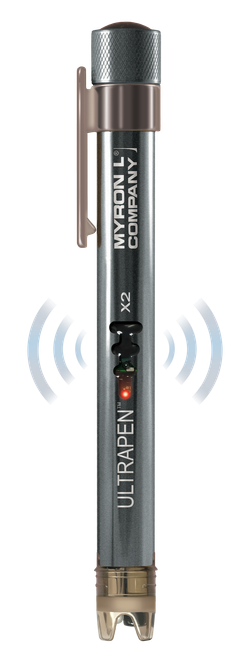
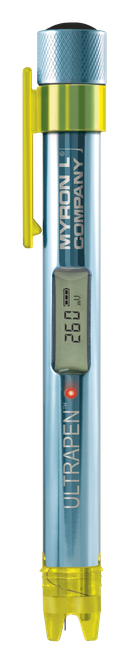
| Product Type | UltrapenX2™ handheld instrument |
| Measures | ORP / Redox & Temperature |
| Country of Origin | United States |
| Measurement |
| ORP Range | −1000 mV to +1000 mV |
| ORP Accuracy | ±10 mV |
| ORP Resolution | 1 mV |
| Temperature Range | 0-71 °C / 32-160 °F |
| Temperature Accuracy | ±0.1 °C |
| Temperature Compensation | Automatic in calibration mode from 15 °C to 30 °C |
| Physical & Power |
| Temperature Compensation | Automatic to 25 °C |
| Battery | One N-type alkaline 1.5 V (installed) |
| Operating / Storage Temperature | 0-55 °C / 32-131 °F |
| Body | Aircraft aluminium, epoxy-encapsulated electronics, waterproof |
| Physical Dimensions | 17.15 cm L × 1.59 cm D / 6.75 in. L × 0.625 in. D |
| Weight | 50.4 g / 1.78 oz |
| Wireless | Bluetooth® — pairs with the UltrapenX2™ (PTBTX2™) mobile application |
What is in the box
PTBT3 pocket tester pen with battery installed, protective cap
Bluetooth® and the UltrapenX2™ app
Pairs with the free UltrapenX2™ (PTBTX2™) application on a mobile device to store readings with time, date and location, and to export the log by email. Check your device against Myron L’s Software Compatibility list before purchase.
Warranty
Two (2) Year Limited Warranty on the instrument. pH and ORP sensors carry a Six (6) Month Limited Warranty. Warranty is limited to repair or replacement at the manufacturer’s discretion and excludes damage from abuse, tampering or environmental extremes.
WHERE THIS IS USED — 6 APPLICATIONS
Myron L publishes an application bulletin for each of these. The summaries below are ours; the linked bulletins are Myron L’s own and open in a new tab.
Boilers & Cooling Towers
Facilities, HVAC, process steam
Boilers and cooling towers concentrate dissolved minerals as water boils off or evaporates, and past a certain point that causes either scale or corrosion. Myron L notes that as little as 1/8 in. of scale can cost a boiler 18% of its efficiency and a cooling-tower heat exchanger 40%. Conductivity or TDS tracks the cycles of concentration so blowdown and bleed-off happen at the right moment — enough to protect the plant, not so much that water and treatment chemicals are wasted.
Measured here: Conductivity / TDS, pH, ORP, temperature, LSI
📄 Boilers & Cooling Towers Application Bulletin (PDF)Environmental Monitoring
Wastewater, stormwater, surface water
Discharge to waterways, to municipal sewers and increasingly stormwater runoff all sit under permit limits, and demonstrating compliance means measuring at many points rather than one. Conductivity, pH, ORP, dissolved oxygen and nitrate together characterise both the health of a receiving water and the quality of an effluent, and handheld instruments make it practical to sample where the water actually is.
Measured here: Conductivity / TDS, pH, ORP, dissolved oxygen, nitrate, temperature
📄 Environmental Monitoring Application Bulletin (PDF)Hemodialysis & Dialysate
Clinical / medical
Dialysate composition directly affects patient safety — errors range from nausea and fatigue through to metabolic acidosis and sepsis. That puts three things under control: the proportioning and mixing of concentrate, the quality of the water it is mixed with, and the water used for reprocessing, maintenance and disinfection. Conductivity is the practical proxy for correct dialysate concentration, which is why dedicated dialysate instruments read in the narrow ranges these solutions occupy.
Measured here: Conductivity, temperature, pH, resistivity
Clinical use. Dialysate and dialysis water monitoring is subject to your facility’s own protocols and to applicable medical device regulation — confirm suitability before specifying.
📄 Hemodialysis & Dialysate Application Bulletin (PDF)Oxidation Reduction Potential (ORP / Redox)
Disinfection, process control, water treatment
ORP measures the strength of the oxidisers and reducers present rather than their concentration, and it is reported in millivolts with no temperature correction. That distinction matters: a chlorine residual tells you how much is there, while ORP tells you how effectively it is actually oxidising. Positive readings indicate an oxidising solution such as chlorinated water; negative readings indicate a reducing agent such as sodium sulfite.
Measured here: ORP / redox, pH, free chlorine equivalent
📄 Oxidation Reduction Potential (ORP / Redox) Application Bulletin (PDF)Reverse Osmosis
Desalination, industrial, medical, drinking water
Conductivity is the standard way to judge RO water quality and membrane performance, because comparing feed against permeate gives percent rejection directly. ORP and pH matter for membrane life rather than product quality: membranes are attacked by oxidisers such as chlorine, bromine, ozone and peroxide, so a high ORP signals a need for pretreatment while a low one can indicate biological activity and fouling. Reading ORP on the reject stream, where concentration is highest, shows even trace oxidisers or reducers.
Measured here: Conductivity / TDS, resistivity, ORP, pH, temperature
📄 Reverse Osmosis Application Bulletin (PDF)Textiles Manufacturing
Wet processing, dyeing, finishing
Wet spinning, sizing, desizing, scouring, bleaching, mercerisation, dyeing and printing all depend on aqueous chemistry, and pH is the primary control in every one of them — it governs how effectively oxidising and reducing agents work and how dye takes up. Holding pH, conductivity or salt concentration, ORP and temperature to target conserves chemicals and energy, keeps shade and quality consistent, and reduces the effluent load that has to be treated before discharge.
Measured here: pH, conductivity / TDS / salt concentration, ORP, temperature
📄 Textiles Manufacturing Application Bulletin (PDF)Application areas are those in which the Myron L® Company’s own application bulletin names this instrument. Bulletins are reproduced unaltered with Myron L’s copyright notices intact. Suitability for a specific installation should be confirmed with us before purchase.
Specifications taken from the UltrapenX2™ PTBT3 Data Sheet and myronl.com, published by the Myron L® Company. Myron L reserves the right to change design, specifications and prices without notice — please confirm critical figures with us before purchase. Myron L®, Ultrameter®, Ultrapen™, UltrapenX2™, TechPro™, PoolPro™, bluDock™, Guardian2™, FCE™ and 442 Natural Water™ are trademarks of the Myron L Company. VALOX® is a registered trademark of SABIC. Bluetooth® is a registered trademark of Bluetooth SIG, Inc.