

Clack Corporation prints this on the published data sheet for this media, word for word: “NOT FOR INSTALLATION IN CALIFORNIA.”
- The media is 40–60% crystalline quartz by weight. That is not a trace impurity, it is most of what is in the bag — taken from Clack Corporation's own safety data sheet.
- Quartz is on California's Proposition 65 list as a cancer-causing chemical. The safety data sheet says so itself, naming Quartz (SiO2) under its Proposition 65 section.
- Clack Corporation prints the restriction but does not give a reason for it, so we cannot tell you their reasoning — only what they wrote.
- Other distributors refuse California orders for this media and say plainly that Proposition 65 is why. One states it as an agreement with their supplier.
The risk is breathing the dust while you load the tank, not the treated water — the media is certified to NSF/ANSI/CAN Standard 61 for drinking water contact, and once it is wetted and in the vessel there is no dust. That is our reading of the documents, not a legal opinion.
We have taken this off direct sale for now. Call 408-969-2688 or email sales@foreverpureplace.com — we will get a direct answer from the manufacturer, quote you if it turns out to be fine, or set you up with one of the alternatives below.
Quoted from the manufacturer's own published documents, checked against the current revisions on the manufacturer's website.
Both do the same job in the same backwashing vessel, and neither manufacturer places a California restriction on them. Call 408-969-2688 if you want us to match one to a water test.
The straight swap for iron and manganese, and the one with nothing to disclose — it is a clinoptilolite media with no crystalline silica at all, and its safety data sheet states plainly that no Proposition 65 chemicals are present. It also filters far finer than Birm, down to 3 micron. It costs more per cubic foot.
The long-established iron and manganese media, widely used in California including in municipal plants, and its manufacturer imposes no California restriction. Be aware it is built on a silica sand core — 90–94% crystalline quartz, more than Birm — so choose it for the absence of a restriction, not for the absence of silica. It also needs an oxidant.
WARNING: This product can expose you to Quartz, which is known to the State of California to cause cancer. For more information go to www.P65Warnings.ca.gov
Wording exactly as published by Clack Corporation in the documentation for this product. Chemical named: Quartz. See www.P65Warnings.ca.gov.
Question? Please contact us
That is almost always dissolved iron in a well supply. It comes out of the tap looking clear, then turns orange in the sink or the toilet cistern as it meets the air. Birm is the filter media that fixes it — and it does so without salt, without chemicals and without cartridges to replace. It simply needs backwashing, which your filter valve does on its own.
- Clear-water iron from a well
- Manganese (black or grey staining)
- Rust stains, metallic taste
- Rotten-egg smell (hydrogen sulfide)
- Chlorinated city water
- Hard water — that needs a softener
Not sure which you have? Send us a water test and we will tell you straight whether this is the right fix — 408-969-2688 or sales@foreverpureplace.com.
How It Works
Birm® is a granular filter media made by Clack Corporation for reducing dissolved iron and manganese from water. It is not a chemical that gets used up — it works as an insoluble catalyst, accelerating the reaction between the dissolved oxygen already in the water and the dissolved iron.
In most well water, iron arrives as ferrous bicarbonate: clear in the glass, then rusty after it stands. In that dissolved state it passes straight through a filter. Birm drives it to oxidise into ferric hydroxide — an insoluble particle — which the bed then physically traps. Backwashing lifts the accumulated iron out to drain. There is no regenerant, no chemical to buy and no salt.
The catch, and it is the whole ball game: the reaction needs oxygen. Clack requires dissolved oxygen of at least 15% of the iron content (29% for manganese). On a closed, oxygen-poor well this often means an air injector or aeration ahead of the filter. Birm fitted to water without enough oxygen will simply not work, and no amount of backwashing fixes it.
Where It Is Used
Birm suits well and borehole supplies with clear-water iron, in homes, farms, light commercial premises and irrigation systems — anywhere the problem is staining, orange-brown deposits in fixtures, or a metallic taste. It works in both pressurised filter vessels and gravity-fed systems.
It is a poor choice, and will fail, where the water carries hydrogen sulfide (rotten-egg smell), oil, heavy organics, chlorine, or polyphosphate dosing, or where pH sits below 6.8. Those waters need a different media — talk to us and we will point you at the right one rather than sell you a bed that will not last.
Will It Work on My Water?
Every line below is a condition Clack states for operation. Treat them as pass/fail, not as targets to aim near.
| Condition | Requirement | Why it matters |
|---|---|---|
| pH — iron removal | 6.8 – 9.0 | Below 6.8 the media is progressively destroyed |
| pH — manganese removal | 8.0 – 9.0 | If iron is also present keep pH below 8.5, or colloidal iron forms and will not filter out |
| Dissolved oxygen | ≥ 15% of the iron content; ≥ 29% of the manganese content | Birm is a catalyst — without dissolved oxygen the reaction does not happen |
| Alkalinity | Greater than 2 × (sulfate + chloride) | Low alkalinity waters need correction first |
| Hydrogen sulfide | None | Destroys the media |
| Oil | None | Coats and blinds the bed |
| Organic matter | 4–5 ppm maximum | Organics coat the grains and stop the catalytic action |
| Chlorine | Free chlorine below 0.5 ppm | Clack’s stated limit. Sustained chlorination greatly reduces Birm’s activity and high concentrations deplete the catalytic coating |
| Polyphosphates | None | Known to coat Birm and stop it removing iron or manganese |
Get a water analysis before buying media. If you send us the results we will tell you whether Birm is the right answer for your water.
Specifications
| Property | Value |
|---|---|
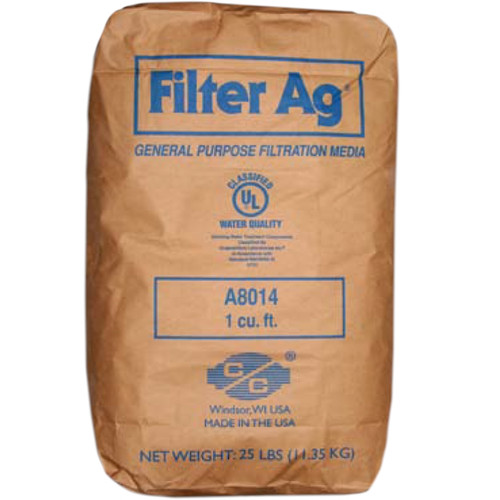
| Media | Birm® — Clack part A8006, 1 cu ft per bag |
| Function | Catalytic filter media for dissolved iron and manganese |
| Density | 36–38 lb/cu ft |
| Mesh size | 12 × 50 |
| Effective size | 0.48 mm |
| Uniformity coefficient | 2.7 |
| Specific gravity | 2.0 g/cc |
| Operating temperature | 35–100°F |
| Bed depth | 30–36 in |
| Freeboard | 50% of bed depth, minimum |
| Service flow | 3.5–5 gpm per sq ft of bed area |
| Backwash flow | 10–12 gpm per sq ft of bed area |
| Backwash bed expansion | 20–40% of bed depth |
| Rinse rate | At service flow rate |
| Certification | NSF/ANSI/CAN Standard 61 |
All figures from the Clack Birm data sheet, Form No. 2350. One bag holds 1 cubic foot, weighing 36–38 lb of media.
Sizing: How Much Do I Need?
Birm is sized on bed area, not on tank volume. The chart shows what each tank diameter demands. The orange bars are the ones that catch people out: backwash needs two to three times the service flow, and if the well pump cannot deliver it the bed never gets properly cleaned, packs down and blinds off.
One bag is 1 cubic foot. The bag count below satisfies both of Clack’s rules at once — a 30–36 in bed and freeboard of at least 50% of that bed depth for expansion during backwash. The right-hand column lists the backwash filter units we stock in that tank size, all supplied less media so this Birm is what goes in them.
| Tank | Birm (bags) | Bed depth | Service flow (gpm) | Backwash needed (gpm) |
|---|---|---|---|---|
| 10" × 44" | 1 | 27" ⚠ | 1.9–2.7 | 5.5–6.5 |
| 10" × 54" | 2 | 33" | 1.9–2.7 | 5.5–6.5 |
| 12" × 48" | 2 | 29" ⚠ | 2.7–3.9 | 7.9–9.4 |
| 13" × 54" | 3 | 33" | 3.2–4.6 | 9.2–11.1 |
| 14" × 65" | 3 | 36" | 3.7–5.3 | 10.7–12.8 |
| 16" × 65" | 4 | 36" | 4.9–7.0 | 14.0–16.8 |
| 18" × 65" | 5 | 36" | 6.2–8.8 | 17.7–21.2 |
| 21" × 62" | 7 | 36" | 8.4–12.0 | 24.1–28.9 |
| 24" × 72" | 9 | 36" | 11.0–15.7 | 31.4–37.7 |
| 30" × 72" | 15 | 36" | 17.2–24.5 | 49.1–58.9 |
| 36" × 72" | 21 | 36" | 24.7–35.3 | 70.7–84.8 |
⚠ Tanks marked with a warning cannot hold a full 30 in bed once the required freeboard is allowed for. They still work, but with a shallower bed they hold less iron between backwashes and will need to regenerate more often. If your iron is above about 3 mg/L, go up a tank size rather than overfilling a short one — filling the freeboard is the single most common way a Birm bed is ruined, because the media can no longer expand and clean itself.
Service and backwash flows are Clack’s 3.5–5 and 10–12 gpm per sq ft applied to the tank cross-section; bed depth is the deepest that still leaves 50% freeboard, capped at Clack’s 36 in maximum. Check the backwash column against your well pump before ordering — it is two to three times the service flow, and a pump that cannot meet it will let the bed pack down. Not sure which size suits your water? Send us an analysis on 408-969-2688 or sales@foreverpureplace.com.
Vessels That Take This Media
Birm goes into a backwashing filter vessel supplied without media. Every unit below ships less filter media — the tank, the backwash control valve and the internals — so this Birm is what you load into it. Sizes match the table above; the valve family is named so you can match it to controls you already run.
Prices shown are current at time of viewing. These are backwash-only filter vessels — they are not softeners and contain no brine system. Check the backwash flow in the table above against your well pump before choosing a size, and talk to us on 408-969-2688 or sales@foreverpureplace.com if you want the sizing confirmed against a water analysis.
Loading It Into the Tank
One bag is 1 cu ft and weighs 36–38 lb of media. Work out the number of bags from the table above.
- Read the safety note below first. Dry Birm gives off a dust that must not be breathed.
- Isolate and depressurise the vessel, then remove the control valve.
- Fit the riser tube and lower distributor. Cap or tape the top of the riser so no media can drop down it — media in the riser ends up in the plumbing.
- Add support gravel first if the system design calls for it, levelling it around the distributor.
- Half-fill the tank with water before adding media. This cushions the fall and stops the distributor being damaged.
- Pour the Birm in slowly through a wide funnel, keeping the riser centred. Fill to a 30–36" bed depth, leaving at least 50% of the bed depth as freeboard above it.
- Uncap the riser, clear any grains from the threads and O-ring seat, and refit the valve.
- Backwash thoroughly before the first service run — 10–12 gpm per sq ft until the water runs clear. This classifies the bed and flushes the fines. Skipping it sends grey fines into the house.
- Rinse at service flow, then return to service.
How Long It Lasts
Birm is a catalyst and is not consumed by doing its job, so there is no fixed replacement interval — and Clack does not publish one. A bed that is correctly sized, correctly backwashed and fed water within the limits above can run for many years. What actually ends its life is one of these:
| What ends the bed’s life | What you will see |
|---|---|
| Attrition from backwashing | Bed depth slowly falls over the years; eventually there is too little media left to hold the iron. Top up or replace. |
| Coating — polyphosphate, oil or organics | Iron starts passing through even though the bed depth and backwash are fine. The grains are blinded and the catalytic surface is masked. |
| Chemical destruction — chlorine, low pH, or no oxygen | Clack’s own guidance: rising treated-water manganese before a backwash may mean the media is being destroyed. If chlorine and hydrogen sulfide are absent, low pH or lack of oxygen are the most likely causes. |
| Cementing / channelling from weak backwash | Pressure drop climbs and flow falls. Usually a pump that cannot meet the backwash rate in the table above. |
How to monitor it, per Clack: test the raw water periodically, and test the treated water for manganese — and iron if present — both shortly before a backwash and immediately after. Iron or manganese breaking through just before a backwash is the earliest warning that the bed is losing capacity. A pressure-drop rise of 2–4 psi above the clean-bed figure is the point to act on.
Because life depends on water chemistry, backwash quality and how much iron the bed handles rather than on elapsed time, a heavily loaded bed on marginal water may need attention in a few years while a well-matched one runs far longer. Testing tells you; a calendar does not.
Technical Detail for Installers — chemistry, backwash design and treatment order
Everything below is for whoever specifies or installs the system. If you are a homeowner, you do not need any of it — the sizing chart above and a word with us will cover you.
Why Clack asks for 15% and 29% dissolved oxygen — it is the chemistry, not a margin
Those two numbers look arbitrary until you write the reactions out. They are the stoichiometric oxygen demand of the reactions Birm catalyses:
O2 per iron = 32 ÷ (4 × 55.845) = 0.143 → 14.3% — Clack requires ≥ 15%
2Mn2+ + O2 + 2H2O → 2MnO2↓ + 4H+
O2 per manganese = 32 ÷ (2 × 54.938) = 0.291 → 29.1% — Clack requires ≥ 29%
So the requirement is the reaction itself, with essentially no margin. Water carrying 5 mg/L iron needs at least 0.75 mg/L dissolved oxygen just to convert it, before any allowance for oxygen demand elsewhere in the water. On a sealed well this is exactly why an air injector is not an optional extra.
The reactions consume alkalinity — which is why Clack sets a floor on it
Both equations release hydrogen ions, so treating iron lowers pH. Working the same equations the other way:
- Iron: 2 H+ per Fe → 100.09 ÷ 55.845 = 1.79 mg/L alkalinity (as CaCO3) consumed per mg/L of iron removed
- Manganese: 2 H+ per Mn → 100.09 ÷ 54.938 = 1.82 mg/L per mg/L
A water at 8 mg/L iron therefore loses roughly 14 mg/L of alkalinity across the filter. On a lightly buffered supply that is enough to walk the pH down toward 6.8 — below which Clack says the media is progressively destroyed. This is the mechanism behind the alkalinity rule (greater than twice the combined sulfate and chloride) and behind beds that mysteriously die after a year on soft, low-alkalinity well water.
Backwash is where most installations fail
Clack specifies 20–40% bed expansion. That lower bound is independently supported: the Pennsylvania Department of Environmental Protection, reporting on more than 1,000 filter plant evaluations, concluded that “20% is a good goal for most plants” and that “as bed expansion begins to drop below the 20% range, the effectiveness of the backwash seems to decline”.
The same study found 28% of the plants surveyed were running at under 10% expansion. Under-backwashing is not an unusual fault — it is the normal one. In a small system the cause is almost always a well pump that cannot hold the backwash rate for the full cycle.
Check it rather than assume it. Run a backwash and confirm the bed lifts. If your vessel has no sight glass, the practical test is drawdown: measure the flow to drain during backwash and compare it against the table below. Flow that sags part-way through the cycle means the pump or the pressure tank, not the media.
Backwash water each cycle — size the drain and check the septic
| Tank | Backwash rate (gpm) | 10-minute backwash | 14-minute backwash |
|---|---|---|---|
| 10" × 44" | 5.5–6.5 | 55–65 gal | 76–92 gal |
| 12" × 48" | 7.9–9.4 | 79–94 gal | 110–132 gal |
| 13" × 54" | 9.2–11.1 | 92–111 gal | 129–155 gal |
| 14" × 65" | 10.7–12.8 | 107–128 gal | 150–180 gal |
| 16" × 65" | 14.0–16.8 | 140–168 gal | 195–235 gal |
| 18" × 65" | 17.7–21.2 | 177–212 gal | 247–297 gal |
| 21" × 62" | 24.1–28.9 | 241–289 gal | 337–404 gal |
| 24" × 72" | 31.4–37.7 | 314–377 gal | 440–528 gal |
| 30" × 72" | 49.1–58.9 | 491–589 gal | 687–825 gal |
A 13" filter backwashing twice a week discharges roughly 800–1,000 gallons a month. That matters if the drain runs to a septic system — it is a common cause of drain-field trouble that gets blamed on the softener. Plan the discharge before the install, not after.
Order of treatment
Where a system has more than one stage, iron removal comes before softening. Iron fouls cation resin and is difficult to strip out of it once it is in. Aeration or oxygen injection comes before the Birm filter; any sediment pre-filter comes before that. Chlorination, if the supply needs it, belongs after the Birm bed — never before, because free chlorine above 0.5 ppm depletes the catalytic coating.
Chemistry above is standard aqueous iron and manganese oxidation, shown in full so the arithmetic can be checked; atomic weights Fe 55.845, Mn 54.938, O 15.999, CaCO3 100.09. Bed-expansion findings are from “Incorporating Filter Bed Expansion Measurements Into Your Backwashing Routine”, K. Anderson and E. Chescattie, Pennsylvania Department of Environmental Protection, presented at the AWWA Water Quality Technology Conference, 2003. Media specifications remain those of the Clack data sheet linked above.
Safety: Read Before Opening a Bag
Clack’s Safety Data Sheet classifies Birm as Carcinogenicity Category 1A — H350, may cause cancer by inhalation, together with H335 (respiratory irritation) and H372 (damage to lungs and central nervous system through prolonged or repeated inhalation). The hazard is the dust, not the media in water.
Do not breathe the dust. Load it outdoors or in a well-ventilated space, wear a suitable respirator along with gloves and eye protection, do not eat, drink or smoke while handling it, and wash thoroughly afterwards. Read the full SDS below before opening a bag.
Warranty
Clack Corporation publishes no warranty on this media, and says so explicitly in the data sheet linked below. Their words:
“They are offered in good faith, but do not imply any warranty or performance guarantee, as conditions and methods of use of our products are beyond our control. As such, Clack makes no express or implied warranties of any kind with respect to this product, including but not limited to any implied warranty of merchantability or fitness for a particular purpose.”
This is normal for filter media and is not a mark against the product. Media performance depends on the water it is fed and how the system is run — neither of which the manufacturer controls. Clack’s own recommendation is that the user determines suitability by testing with their own equipment.
What that means in practice: the conditions in the table above are the warranty. A bed fed water inside those limits and backwashed at the stated rate will do its job; one fed chlorinated, oxygen-poor or low-pH water will not, and that is not a manufacturing fault. Send us a water analysis before you buy and we will tell you honestly whether Birm suits your supply.
For anything covered by our own sale terms — short shipment, transit damage, or the wrong item supplied — contact us on 408-969-2688 or sales@foreverpureplace.com. Those are our terms, separate from the manufacturer’s position above.
Manufacturer Documentation
📄 Clack Birm Data Sheet (PDF) ⚠️ Clack Birm Safety Data Sheet (PDF)
Both documents are Clack Corporation’s own: data sheet Form No. 2350 (16 September 2019) and Safety Data Sheet revision 28 September 2022. Every specification, limit and flow rate on this page is taken from them. Confirm the current revision with us before designing around these figures.
Frequently Asked Questions
How often does Birm need to be replaced?
There is no fixed interval, and that is not evasion — Birm is a catalyst and is not consumed by removing iron. It makes the reaction happen; the iron it precipitates is flushed to drain at every backwash, and the media itself is still there afterwards. Clack publishes no service life figure for it.
To give a sense of scale, this is how much iron a bed actually handles in a year — all of it backwashed away, none of it using up the media:
| Household / usage | 1 mg/L iron | 3 mg/L iron | 5 mg/L iron | 10 mg/L iron |
|---|---|---|---|---|
| 2 people, ~150 gal/day | 0.5 lb/yr | 1.4 lb/yr | 2.3 lb/yr | 4.6 lb/yr |
| Family of 4, ~300 gal/day | 0.9 lb/yr | 2.7 lb/yr | 4.6 lb/yr | 9.1 lb/yr |
| Large household, ~500 gal/day | 1.5 lb/yr | 4.6 lb/yr | 7.6 lb/yr | 15.2 lb/yr |
| Light commercial, ~1,500 gal/day | 4.6 lb/yr | 13.7 lb/yr | 22.8 lb/yr | 45.7 lb/yr |
Calculated as gallons/day × mg/L × 365 × 3.785 ÷ 453,592.
In practice, beds kept inside Clack’s stated water limits and backwashed at the full rate commonly run five to ten years or more, with a top-up as attrition slowly reduces the bed depth. That range is general field experience with catalytic iron media, not a manufacturer specification — Clack does not publish one, and anyone quoting you a guaranteed lifespan is guessing.
What shortens it is never elapsed time. It is one of four things: attrition from years of backwashing, coating by polyphosphate, oil or organics, chemical destruction from chlorine, low pH or too little oxygen, or cementing from a backwash that never had enough flow. Water that sits inside the limits will outlast water that sits at the edge of them by years.
How is Birm packed into a filtration tank?
In layers, wet, with the riser tube protected. The order matters:
- Distributor and riser first. Fit the lower distributor basket on the riser tube, stand it centred on the tank floor, then cap or tape the top of the riser. Any media that drops down an open riser ends up in the house plumbing.
- Support gravel, if the design uses it. Pour it in first and level it so the distributor is buried and the bed above it sits flat. Gravel stops fine media reaching the distributor slots.
- Half-fill with water before the media goes in. This is the step people skip. The water cushions the fall, stops the distributor being cracked, and starts wetting the grains so they settle evenly instead of bridging.
- Pour the Birm slowly through a wide funnel, keeping the riser central. Do not tip a whole bag in at once — it packs unevenly and traps air.
- Fill to bed depth, not to the top. Clack calls for a 30–36 in bed with freeboard of at least 50% of bed depth above it. That empty space is not waste — it is where the bed expands 20–40% during backwash. Fill it with media and the bed cannot fluidise, so it will never clean itself.
- Clear the threads. Uncap the riser, brush every grain off the tank threads and O-ring seat, then fit the valve. A single grain on the seal is a slow leak.
- Backwash before the first service run at 10–12 gpm per sq ft until the water runs clear. This classifies the bed — fines rise to the top, coarse settles — and flushes the dust out to drain instead of into the house.
The media is never compacted deliberately. Backwashing sets the bed; your job is to get it in cleanly, wet, and to the right depth.
Does Birm need a gravel underbed or other media layered with it?
Birm itself does not require one. Clack’s data sheet specifies bed depth, freeboard, flow rates and water chemistry — it says nothing about gravel, support media or underbedding. Whether you use an underbed is a property of the vessel and its distributor, not of the media.
In practice:
- Most residential tanks with a proper basket distributor need no gravel. The basket screen is fine enough to hold Birm back on its own. Birm is 12 × 50 mesh with a 0.48 mm effective size — not a fine powder.
- Larger-diameter vessels and hub-and-lateral underdrains usually do use a graded gravel underbed. It spreads backwash flow evenly across a wide tank floor and stops media reaching the laterals. Without it a big bed tends to channel.
- Follow the vessel manufacturer’s instruction, not a rule of thumb. If the system was supplied with gravel, use it and use the stated amount; if it was not, adding some is not an upgrade.
Birm is a single-media bed — it is not layered with anthracite, sand or carbon. It is not a multimedia filter, and mixing other filter media into the same bed defeats it: the layers classify differently during backwash, the Birm ends up buried or carried off, and the catalytic surface stops seeing the water it needs to treat. If you also need sediment or taste-and-odour treatment, that belongs in a separate vessel.
The one thing that is always required above the bed is freeboard — at least 50% of the bed depth of empty space, so the bed can expand 20–40% during backwash. That is the space people mistakenly fill with more media.
How do I know when it actually needs replacing or topping up?
Test, do not guess. Clack’s own method: check the treated water for manganese — and iron if present — shortly before a backwash and again immediately after. Iron or manganese breaking through just before a backwash is the earliest warning that the bed is losing capacity.
Three other signals worth watching:
- Pressure drop up 2–4 psi from the clean-bed figure — Clack’s stated limit, and the point to act.
- Bed depth falling below 30 in — measure it; attrition is gradual and easy to miss.
- Backwash water running clear too quickly, which usually means the bed is channelling rather than fluidising.
If iron is passing through but the bed depth and backwash flow are both fine, the grains are almost certainly coated — look upstream for polyphosphate dosing, oil or organics before buying new media.
Does Birm need chemicals, salt or regeneration?
No. Birm needs no regenerant, no potassium permanganate and no salt — it is cleaned by backwashing alone. That is its main running-cost advantage over greensand, which does need regular permanganate regeneration.
The trade-off is that Birm is fussier about the water it is given: it needs dissolved oxygen and a pH of at least 6.8, where greensand is more tolerant.
Do I need an air injector or aerator?
Often, yes. Birm is a catalyst for the reaction between dissolved oxygen and dissolved iron, so the oxygen has to be there already. Clack requires dissolved oxygen of at least 15% of the iron content, and 29% for manganese.
Many closed wells are oxygen-poor, and on those an air injector, aeration tank or venturi ahead of the filter is not optional — without it the bed will simply not work, no matter how well it is sized or backwashed. If your water sits in an open or vented tank first, you may already have enough.
Will Birm remove hydrogen sulfide, the rotten-egg smell?
No — and worse, hydrogen sulfide destroys Birm. Clack lists it as a condition the media must not see at all. If your water smells of rotten eggs, Birm is the wrong choice and fitting it will cost you the bed.
Tell us what your analysis shows and we will point you at a media that handles sulfide instead.
Can I use Birm on chlorinated or city water?
No. Clack states that chlorination greatly reduces Birm’s activity and that high concentrations of chlorine compounds deplete the catalytic coating. Birm is a well-water media.
The same applies to anything dosed upstream: polyphosphates are specifically named as coating the media and stopping it removing iron or manganese. Before adding any chemical ahead of a Birm bed, its compatibility should be tested.
How much Birm do I need?
It is sized on bed area, not tank volume. A 30 in bed — Clack’s minimum — needs roughly 1.5 cu ft in a 10 in tank, 2 cu ft in a 12 in, 2.3 cu ft in a 13 in and 3.5 cu ft in a 16 in. The full table and the matching flow requirements are in the sizing section above.
Check the backwash column before you buy: backwash needs two to three times the service flow, and a well pump that cannot supply it will let the bed pack down.
Can Birm share a tank with softener resin?
No. They need different service and backwash rates and different bed positions, and a softener’s brine regeneration would ruin the Birm bed. Iron filtration and softening belong in separate vessels, with the iron filter first so the softener is protected from the iron.
Is the dust dangerous to handle?
Yes, and it should be taken seriously. Clack’s Safety Data Sheet classifies Birm as Carcinogenicity Category 1A — H350, may cause cancer by inhalation, with H335 respiratory irritation and H372 organ damage from prolonged or repeated inhalation. The hazard is the dry dust, not the media once it is wet and in the tank.
Load it outdoors or in a well-ventilated space, wear a suitable respirator with gloves and eye protection, and do not eat, drink or smoke while handling it. The full SDS is linked above — read it before opening a bag.
Specifications and operating limits quoted here come from the Clack Birm data sheet and Safety Data Sheet linked above. Service-life ranges are general field experience and are not a manufacturer guarantee. Send us a water analysis and we will tell you whether Birm suits your supply — 408-969-2688 or sales@foreverpureplace.com.