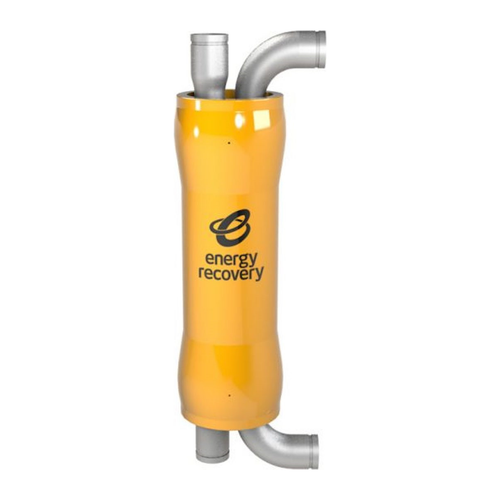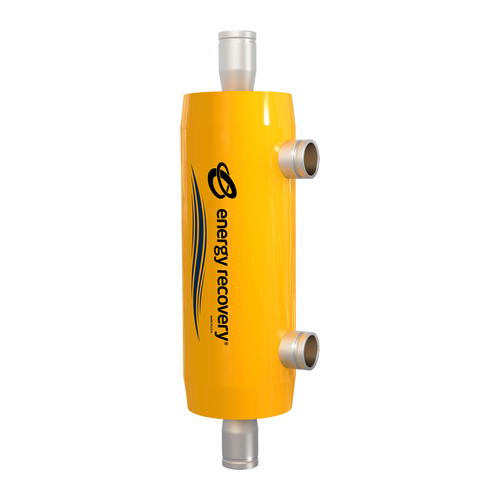


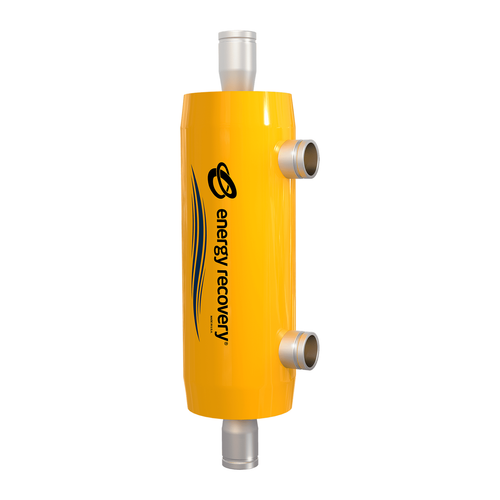
The Energy Recovery PX L140 Pressure Exchanger® is a positive-displacement energy recovery device for brackish-water and low-pressure reverse osmosis. A single ceramic rotor transfers pressure energy directly from the high-pressure reject stream to the incoming feed, at up to 95% peak efficiency, handling 90 - 140 gpm (20.4-31.8 m3/h) per device. There is no gearbox, no pistons and no lubricating oil — the rotor is the only moving part.
Documentation & Drawings
Technical Specifications
| Operating Conditions | |
| Service | LPRO |
| Liquid | Brackish Water |
| Flow range | 90 - 140 gpm (20.4-31.8 m3/h) |
| Maximum high-pressure inlet flow | 140 gpm (31.8 m3/hr) |
| Maximum low-pressure outlet flow | 140 gpm (31.8 m3/hr) |
| Maximum inlet high pressure | 450 psi (31 bar) |
| Maximum inlet low pressure | 150 psi (10.3 bar) |
| Minimum discharge pressure | 9 psi (.62 bar) |
| Operating temperature | 33°F-120°F (0.6-49°C) |
| Maximum temperature | 120°F (49°C) |
| Specific gravity | 1.01 |
| Viscosity | 0.991 cP @ 70°F (21.1°C) |
| Filtration requirement (nominal) | 20 µm |
| Performance | |
| Peak efficiency | 95% |
| Maximum high-pressure differential | 8.7 psi (0.60 bar) |
| Maximum low-pressure differential | 8.4 psi (0.58 bar) |
| Maximum lubrication flow | 2.0 gpm (0.45 m3/hr) |
| Maximum salinity increase at membranes | 3% @ 40% Recovery |
| Noise per ISO 3744 | Less Than 85 dB(A) |
| Materials of Construction | |
| Housing | GRP |
| Rotor, sleeve & endcover assembly | Ceramic-alumina |
| Port fittings | 316 SS |
| Internal low-pressure interconnector | PVC |
| Tension rod assembly | 316 SS |
| Fasteners & hardware (non-wetted) | 316 SS |
| O-rings | EPDM |
| Shipping Weight & Dimensions | |
| Unit shipping weight | 205 lbs. (93.0 kg) |
| Dry unit weight | 196 lbs. (88.9 kg) |
| Cartridge weight | 65 lbs. (29 kg) |
| Identification | |
| Manufacturer | Energy Recovery, Inc. (San Leandro, CA) |
| Model | PX-L140 |
| Data sheet reference | ERI 80933-01 |
How the PX Pressure Exchanger Works
A ceramic rotor turns inside a sleeve. Each duct is alternately opened to the high-pressure concentrate leaving the membranes and to the low-pressure feed entering the system. The high-pressure stream pushes directly against the feed water inside the duct, transferring its pressure with almost no loss; the duct then rotates, the depressurised stream is flushed to drain, and the cycle repeats. Because the transfer is direct hydraulic displacement rather than a mechanical conversion, efficiency is very high and the only moving part is the rotor.
Watch the PX in Operation
Video courtesy of Energy Recovery, Inc.
Where the PX-L140 Fits
The PX-L140 is specified on brine (concentrate) flow, not permeate — the pressure exchanger sits on the reject stream. ERI rates it for 90–140 gpm of brine at up to 450 psi, at 95% efficiency.
At the 70–80% recovery typical of brackish water, wastewater and reuse systems, one unit at full flow supports roughly 470,400–806,400 GPD of permeate (1,781–3,053 m³/day). That places a single PX-L140 in utility-scale brackish and reuse plants, and industrial minimal-liquid-discharge trains.
PX units are installed in parallel arrays, so larger plants simply use more of them — four PX-L140 units cover about 7,123–12,210 m³/day on the same basis. Below 90 gpm of brine, step down to a smaller model rather than run this one under its minimum.
Capacity figures are indicative, derived from the rated brine flow at typical recovery. Actual output depends on your feed salinity, temperature, membrane configuration and recovery rate — send us your design conditions and we will confirm the model and the number of units.
Frequently Asked Questions
How many PX-L140 units do I need?
What pre-filtration is required?
Does it need a motor?
What maintenance is involved?
How much energy does it save?
Specifications reproduced from the Energy Recovery technical data sheet for this model. PX® and Pressure Exchanger® are registered trademarks of Energy Recovery, Inc. ERI reserves the right to make specification changes without prior notice; confirm critical values against the current data sheet before purchase.