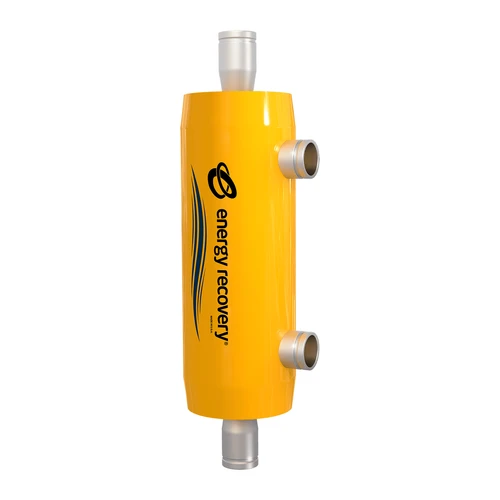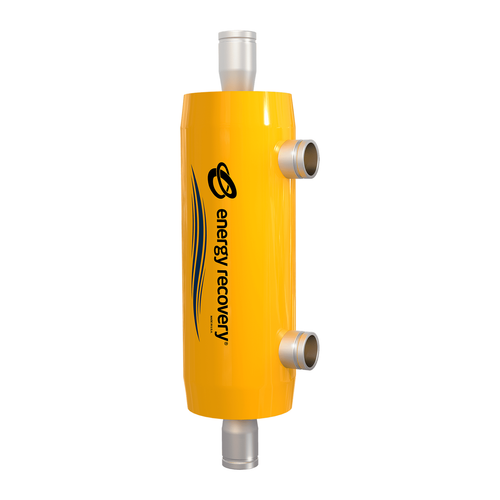


The Energy Recovery PX-140S Pressure Exchanger® is the largest device in ERI's 4S-Series, recovering pressure energy from the high-pressure reject stream of a seawater reverse osmosis system. Unlike the smaller 4S models it is a dual-rotor device: it carries two ceramic cartridges either side of a centre manifold, with dual HP OUT and LP IN connections and single HP IN and LP OUT connections.
Documentation
Technical Specifications
| Operating Conditions | |
| Service | Seawater reverse osmosis (SWRO) |
| Allowable flow rate | 90 – 140 gpm (20.4 – 31.8 m³/h) |
| Maximum high pressure (HP IN or HP OUT) | 1,200 psig (82.7 bar) |
| Maximum feedwater inlet pressure (LP IN) | 300 psig (20.7 bar) |
| Minimum feedwater inlet pressure (LP IN) | 27 psig (1.9 bar) |
| Minimum brine discharge pressure (LP OUT) | 15 psig (1.0 bar) |
| Minimum filtration requirement (nominal) | 5 micron |
| Seawater temperature range | 33 – 120°F (1 – 49°C) |
| pH range | 1 – 12 (short term at limits) |
| Configuration | |
| Series | ERI 4S-Series |
| Rotor arrangement | Dual rotor — two ceramic cartridges with centre manifold |
| Connections | Dual HP OUT and LP IN; single HP IN and LP OUT |
| Cartridge note | Top and bottom cartridges differ — the lower is a mirrored version |
| Mounting orientation | Vertical, horizontal or any other orientation |
| Spare Parts | |
| Spares kit | 4S Dual Rotor Spares Kit — ERI P/N 20019-01 |
| Not compatible with | 20018-01 (single-rotor kit for PX-45S / -70S / -90S) |
| Identification | |
| Manufacturer | Energy Recovery, Inc. (San Leandro, CA) |
| Model | PX-140S (4S-Series) |
| Reference document | ERI 80022-01, Installation, Operation & Maintenance Manual |
4S-Series Flow Ranges
| PX-45S | 25 – 45 gpm (5.7 – 10.2 m³/h) |
| PX-70S | 40 – 70 gpm (9.1 – 15.9 m³/h) |
| PX-90S | 60 – 90 gpm (13.6 – 20.4 m³/h) |
| PX-140S | 90 – 140 gpm (20.4 – 31.8 m³/h) |
How the PX Pressure Exchanger Works
A ceramic rotor turns inside a sleeve. Each duct is alternately opened to the high-pressure brine leaving the membranes and to the low-pressure feed entering the system. The high-pressure stream pushes directly against the feed water inside the duct, transferring its pressure with almost no loss; the duct then rotates, the depressurised brine is flushed to drain, and the cycle repeats. The PX-140S performs this cycle in two rotors simultaneously.
Backpressure note: the low-pressure discharge stream must be constricted to provide backpressure. Without it, the noise profile increases and destructive cavitation can occur.
Watch the PX in Operation
Where the PX-140 Fits
The PX-140 is specified on brine (concentrate) flow, not permeate — the pressure exchanger sits on the reject stream. ERI rates it for 90–140 gpm of brine at up to 1,200 psi, at 94.8% efficiency.
At the 40–45% recovery typical of seawater systems, one unit at full flow supports roughly 134,400–164,945 GPD of permeate (509–624 m³/day). That places a single PX-140 in resort and hotel complexes, small municipal supply, food and beverage process water, and containerised plants at the larger end of the range.
PX units are installed in parallel arrays, so larger plants simply use more of them — four PX-140 units cover about 2,035–2,498 m³/day on the same basis. Below 90 gpm of brine, step down to a smaller model rather than run this one under its minimum.
Capacity figures are indicative, derived from the rated brine flow at typical recovery. Actual output depends on your feed salinity, temperature, membrane configuration and recovery rate — send us your design conditions and we will confirm the model and the number of units.
Frequently Asked Questions
Is the PX-140S the same as the PX-Q140?
Which spares kit does it take?
What filtration does the 4S-Series need?
Can it be mounted horizontally?
Should I be considering a newer model instead?
Specifications quoted from Energy Recovery 4S-Series Installation, Operation & Maintenance Manual, ERI document 80022-01 rev 4. PX® and Pressure Exchanger® are registered trademarks of Energy Recovery, Inc.